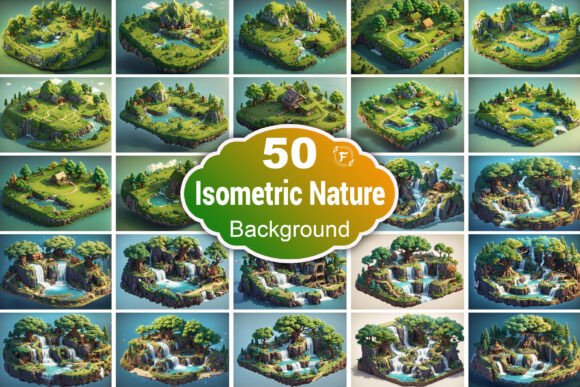
3D Isometric Nature Environment: Strategic Visual Assets for Modern Creators
In an era where digital attention is the most scarce resource, visual communication has shifted from merely decorative to fundamentally strategic. For entrepreneurs, marketers, educators, and designers, the ability to convey complex ideas quickly and aesthetically is a competitive advantage. This is where 3D Isometric Nature Environment assets emerge not just as pretty pictures, but as functional tools for branding, product design, and content strategy. By leveraging high-quality, scalable vector-style illustrations rendered in three dimensions, creators can build immersive brand experiences that resonate with audiences seeking authenticity and depth.
The specific bundle of 50 JPG files, sized at 3000×2000 pixels, offers more than just variety; it provides a cohesive library of natural elements—forests, mountains, water bodies, and flora—rendered in an isometric perspective. This perspective is particularly powerful because it mimics the way we view miniature worlds or architectural models, creating a sense of order, clarity, and manageability amidst the chaos of information overload. When applied correctly, these visuals do not simply fill space; they guide the viewer’s eye, establish tone, and reinforce brand values related to growth, stability, and organic progress.
The Strategic Value of Isometric Design in Branding
Isometric projection is a method of graphical representation in which three-dimensional objects are drawn so that all three axes appear equal in scale. Unlike traditional perspective drawing, which uses vanishing points and can distort proportions, isometric art maintains parallel lines and consistent scaling. This makes it inherently suitable for technical diagrams, infographics, and user interface design. However, when combined with the soft, organic textures of a 3D Isometric Nature Environment, the result is a unique aesthetic that balances precision with warmth.
For small business owners and freelancers, this balance is crucial. A tech startup might use isometric graphics to explain their SaaS platform, but by integrating nature-themed elements, they signal sustainability, eco-friendliness, or human-centric values. Similarly, educational institutions can use these visuals to make learning materials feel less rigid and more inviting. The strategic decision here is to choose a visual language that aligns with your core message. If your brand stands for innovation grounded in reality, the structured yet natural look of isometric nature scenes communicates exactly that.
Operational Efficiency Through High-Resolution Asset Libraries
One of the biggest bottlenecks in creative production is the time spent sourcing, licensing, and editing images. A standard workflow might involve searching stock photo sites, negotiating licenses, cropping images to fit specific aspect ratios, and adjusting color profiles to match brand guidelines. This process consumes valuable hours that could be spent on strategy or client acquisition.
By utilizing a pre-packaged bundle like the one described—containing 50 JPG files in a convenient zip folder—you streamline the operational side of design. Each file is provided in RGB color mode and at a substantial resolution of 3000×2000 pixels. This resolution is critical for two reasons. First, it ensures crisp output for large-format prints such as wall art, banners, and exhibition backdrops without pixelation. Second, it provides ample "digital breathing room" for editors to crop, zoom, and manipulate the images for social media thumbnails or website headers while retaining quality.
Consider the scenario of a marketing manager launching a multi-channel campaign. They need a hero image for a blog post, a banner for LinkedIn, a background for an email newsletter, and a print-ready poster for a trade show. With a single download of 50 high-resolution isometric nature backgrounds, they have a diverse set of options that maintain visual consistency across all channels. This consistency builds brand recognition, reducing the cognitive load on customers who encounter your content across different platforms.
Diversifying Revenue Streams with Print-on-Demand and Physical Products
For creators looking to diversify income, the versatility of 3D Isometric Nature Environment illustrations opens doors to multiple revenue streams. The transition from digital asset to physical product is seamless when the source material is high-quality. Sublimation printing, for instance, requires vibrant colors and sharp details to transfer effectively onto fabrics and hard surfaces.
- Apparel and Accessories: T-shirts, hoodies, and tote bags benefit from the clean lines and distinct shapes of isometric art. The nature theme appeals to consumers interested in outdoor activities, mindfulness, and sustainable living. By placing these designs on apparel, you are not just selling clothing; you are selling an identity.
- Home Décor and Wall Art: The 3000×2000 pixel dimension is ideal for framing. Customers increasingly seek decor that adds depth to their living spaces without overwhelming them. Isometric landscapes offer a window into another world, providing a sense of escape and tranquility. These pieces can be marketed as "boho-chic" or "modern minimalist" depending on how they are framed and displayed.
- Stationery and Planners: In the realm of productivity, aesthetics play a significant role in adoption. Journals, planners, and notebooks featuring serene nature environments can enhance the user experience, making the act of planning feel more meditative and organized. Educators and coaches can also use these designs for worksheets and handouts, adding a professional yet approachable touch to their teaching materials.
Intentional Application: Avoiding Visual Clutter
While the potential applications are vast, the risk of misusing these assets lies in over-saturation. A common mistake among novice designers is layering too many elements, resulting in a cluttered composition that confuses rather than clarifies. When using 3D Isometric Nature Environment backgrounds, it is essential to practice restraint. The strength of these images is their atmospheric quality; they should serve as a foundation, not a distraction.
To mitigate this risk, adopt a strategic approach to placement. If you are designing a website header, ensure there is sufficient negative space for text overlay. Use semi-transparent overlays or blur effects if necessary to improve readability. When creating social media posts, consider using the isometric scene as a subtle backdrop behind key typography or call-to-action buttons. The goal is to enhance the message, not compete with it.
Furthermore, consider the psychological impact of the color palette. Nature environments often feature greens, blues, and earth tones, which are associated with calmness, trust, and growth. Align these colors with your brand’s emotional goals. If you are promoting a financial service, the stability implied by mountainous isometric views can reinforce reliability. If you are marketing a wellness app, the lush forests can evoke relaxation and rejuvenation. Every visual choice should support the narrative you are trying to construct.
Long-Term Planning and Scalability
Investing in a comprehensive asset library is a long-term strategy. Trends in graphic design change rapidly, but the fundamental appeal of well-crafted, thematic illustrations remains constant. By building a library of 50 cohesive images, you create a reusable ecosystem for your brand. You can rotate through these backgrounds seasonally, updating your website or marketing materials without the cost and delay of commissioning new artwork.
This scalability extends to team collaboration. When multiple designers or freelancers work on a project, having a shared repository of approved, high-quality backgrounds ensures uniformity. It reduces the friction of version control and allows teams to focus on execution rather than asset creation. For agencies managing multiple clients, offering customized isometric nature themes as part of a branding package can add significant perceived value.
Conclusion: Making Informed Creative Decisions
The decision to incorporate 3D Isometric Nature Environment illustrations into your projects should be driven by clear objectives. Whether you are aiming to boost engagement on social media, increase conversion rates through better landing page design, or launch a line of physical products, these assets provide a versatile and professional starting point. By understanding the technical specifications, such as the 3000×2000 pixel resolution and RGB color mode, and applying strategic principles of layout and color psychology, you can transform simple images into powerful business tools.
Ultimately, the value of these files lies not just in their aesthetic appeal, but in their ability to facilitate better communication. In a crowded digital landscape, clarity and beauty are rare commodities. By choosing to present your ideas through the lens of an organized, natural, and three-dimensional world, you invite your audience to pause, engage, and connect. This is the essence of effective design: using visual structure to support human understanding and emotional resonance.